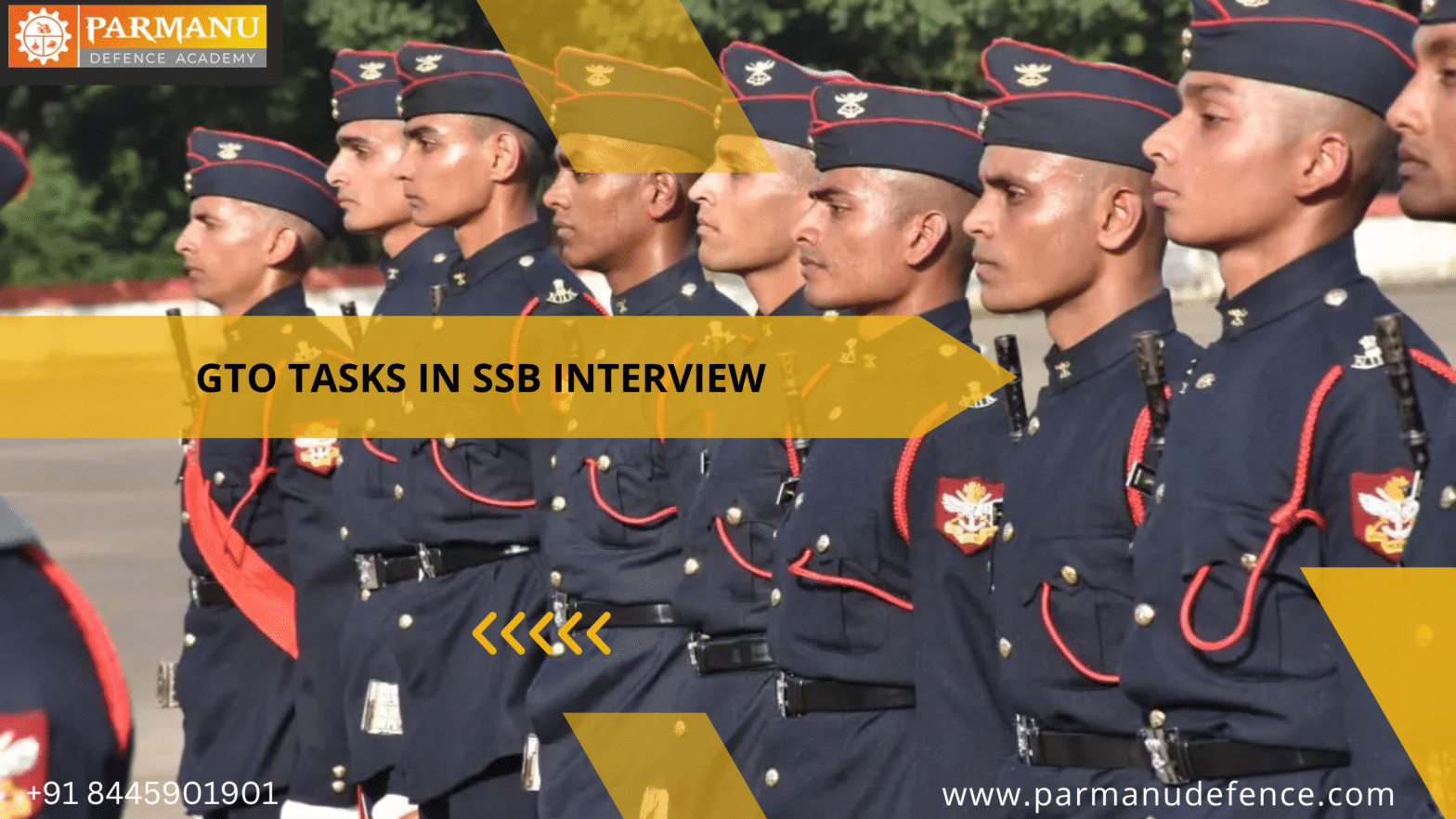
GTO Tasks in the SSB Interview are a set of indoor and outdoor group and individual tests done by the Group Testing Officer (GTO) in Stage 2 of the SSB Interview. These tests are aimed at examining the thought processes of a candidate, his planning skills, team spirit, and leadership skills while solving a practical problem under time constraints. This article describes the content of the GTO Tasks List along with details of each test and the qualities that they assess.
GTO means Group Testing Officer. This officer is responsible for carrying out the group tests in SSB and observing the candidates during the process. GTO forms one of the three evaluating groups in the board. The other two groups include psychologists and interview officers. Every group arrives at their independent judgment, and then a consensus decision is made through a conference.
GTO tasks are carried out after the screening process in the SSB, which involves the OIR test and PPDT test. Candidates who pass the screening process undertake the group tasks on the third and fourth day of the five-day program.
The table below summarises the main SSB group tasks. Exact order and timing can vary by SSB centre.
| No. | Task | Type | Main Focus |
|---|---|---|---|
| 1 | Group Discussion (GD) | Indoor, group | Communication and reasoning |
| 2 | Group Planning Exercise (GPE) | Indoor, group | Planning and decision-making |
| 3 | Progressive Group Task (PGT) | Outdoor, group | Teamwork and problem-solving |
| 4 | Half Group Task (HGT) | Outdoor, half group | Initiative and leadership |
| 5 | Lecturette | Indoor, individual | Confidence and expression |
| 6 | Individual Obstacles (IO) | Outdoor, individual | Courage and physical ability |
| 7 | Command Task (CT) | Outdoor, individual | Leadership and organisation |
| 8 | Final Group Task (FGT) | Outdoor, group | Cooperation and overall behaviour |
A short group obstacle race is also commonly included near the end of the outdoor programme.
In the group discussion phase of the SSB selection procedure, candidates are provided topics related to current affairs, social issues, or general awareness. The group discusses the topic for a certain amount of time without having any particular leader. The GTOs evaluate which candidate listens actively, adds good points and helps the group conclude in a proper manner.
Important Points: Talk in a clear voice, wait for your chance to speak, give support to other people’s ideas and never shout.
Group Planning Exercise is another name for Military Planning Exercise. In this exercise, a model is provided with a story and a problem, like a village in crisis or a security situation. The candidates prepare their individual plan first, and after that, they discuss their plans and make a common plan.
Important Points: Carefully read the problem, identify available resources, prioritise the tasks and create a realistic plan.
Progressive Group Task is the first outdoor task. The group will need to navigate through various obstacles. At each level, there will be an increase in difficulty. Restrictions like not touching restricted places and the use of helping materials will apply. The group will have to carry the required load within the allotted time.
Key Points: Give a clear plan, think about safety, listen to your team members, and keep going if the initial plan fails.
For the half group task, the group will split into two. They will attempt different obstacles individually. With a smaller number of people in the group, individual behaviour can be easily observed, and they get more chances to perform.
Key Points: Contribute in the beginning, help the team member who is performing the move, and stay involved during the whole process.
In the lecturette in SSB, a candidate chooses one topic from a few given options and speaks about it for around three minutes after a short preparation time. Topics can come from current affairs, defence, science, sports, society or general knowledge.
Key points: Open with a brief introduction, speak in a logical order and close with a short conclusion. A calm voice and eye contact make the delivery more effective.
The individual obstacles are a course of around ten obstacles that a candidate attempts alone within a time limit. Each obstacle carries different points, and candidates may choose the order in which to attempt them. Candidates who try boldly while keeping to the rules are viewed positively.
Key points: Understand the rules, attempt obstacles confidently and avoid taking unsafe risks. Good physical fitness helps with performance here, and defence aspirants often include running and strength practice in their routine, as followed in many NDA foundation programmes.
In the command task, each candidate is designated as the commander for a small task. The candidate picks two assistants out of the group and utilises them to perform a task that involves some obstacle. The commander explains the task to them and assigns tasks.
Key points: Give clear directions, maintain your composure, work with the assistants and perform the task within the allotted time frame.
The final group task is the last big outdoors activity. It is more or less like the progressive group task but less complicated. By now, the GTO would have observed the candidates for a few days, and this task would be the ultimate test for their cooperation and behaviour.
Key points: Maintain consistency, do not change your behaviour at the last moment and perform as a team.
All GTO tasks are used to observe a set of Officer Like Qualities (OLQs). The commonly discussed qualities are grouped in four categories:
| Factor | Qualities |
|---|---|
| Planning and organising | Effective intelligence, reasoning ability, organising ability, power of expression |
| Social adjustment | Social adaptability, cooperation, sense of responsibility |
| Social effectiveness | Initiative, self-confidence, speed of decision, ability to influence the group, liveliness |
| Dynamic factor | Determination, courage, stamina |
A candidate is rarely expected to be perfect in every category. Assessors look for a balanced personality with consistent behaviour.
Aspirants from all three services, whether targeting the Indian Army, Indian Navy or Indian Air Force, go through similar GTO assessments.
GTO tasks are group and individual exercises, including group discussion, group planning, progressive group task, half group task, lecturette, individual obstacles, command task and final group task, used to assess Officer Like Qualities.
There are generally eight main tasks, and a group obstacle race is usually added. The sequence can vary slightly between SSB centres.
GTO tasks are usually conducted over the third and fourth days of the five-day SSB, after Stage 1 screening and the psychological tests.
The Group Testing Officer conducts and observes the tasks, with assistance from other assessors at the board.
Basic fitness is useful, especially for the individual obstacles and outdoor group tasks, but the tasks mainly test thinking, cooperation and leadership rather than athletic skill.
Yes. Assessors look for a mix of qualities such as cooperation, responsibility and initiative. A candidate does not need to dominate the group.
The SSB test tasks on GTO assess the behaviour of an applicant in solving a practical problem in a team in the given period of time. The knowledge of the purpose of each task, awareness of its rules, and the development of the habit of honest teamwork and open communication help cope with this test better. It is much more important to be well-prepared than to please the examiners.
Parmanu Defence © Copyright 2025.All Rights Reserved