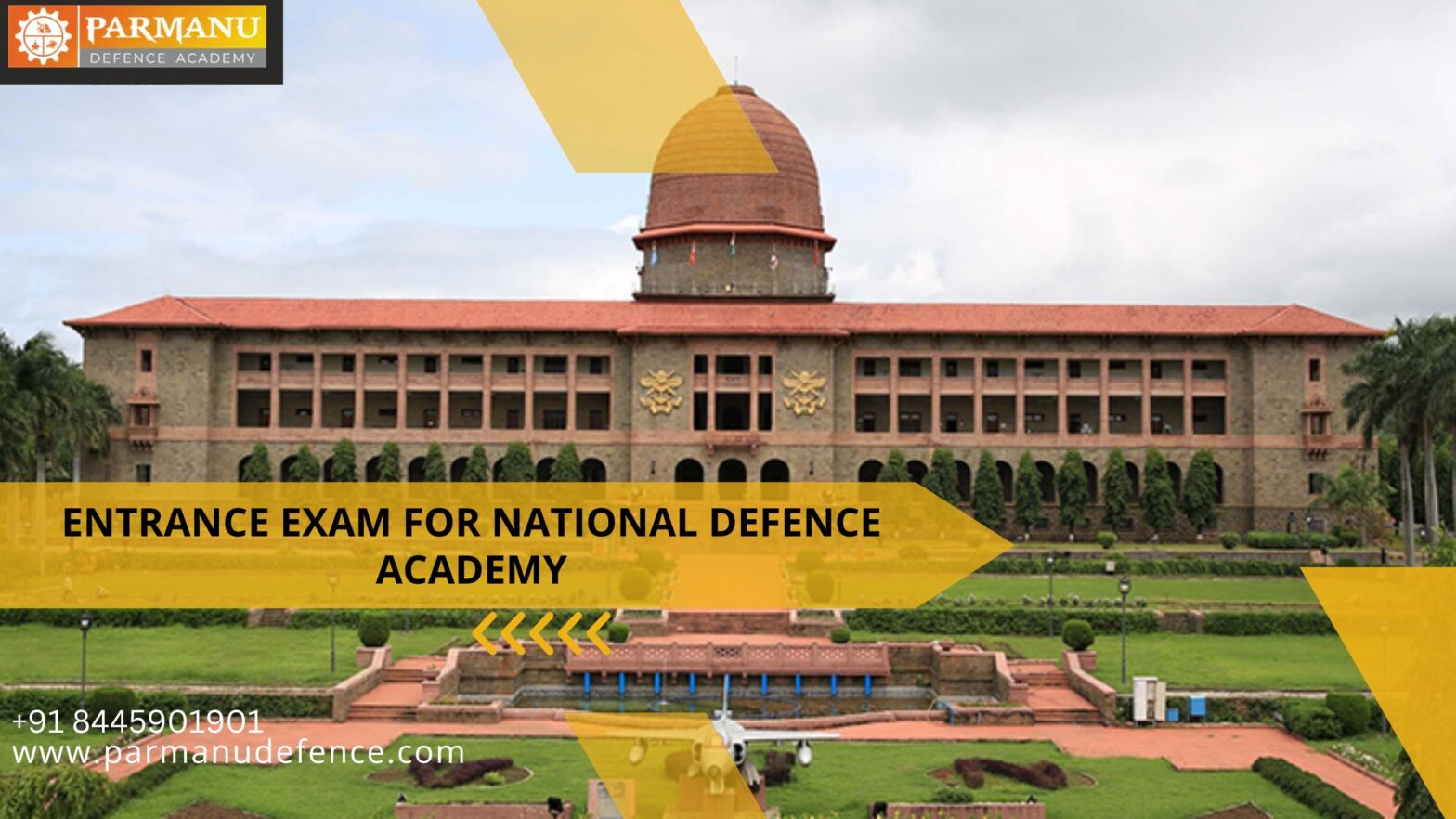
The Entrance Exam for National Defence Academy serves as the exclusive entry point that recognises the aspirations of thousands who wish to become officers in the Indian Armed Forces. The Union Public Service Commission (UPSC) administers this national examination, which evaluates your academic abilities, physical capabilities and leadership skills.
The upcoming NDA 1 2026 and NDA 2 2026 testing cycles present their most intense competition yet. The guide shows you all the necessary information about the syllabus requirements and eligibility criteria, and the best methods to prepare for the Entrance Exam for National Defence Academy.
Before diving into the books, you must understand the “battlefield” layout. The NDA exam takes place two times every year, with its first session, the NDA I exam, occurring in April and its second session, the NDA II exam, taking place in September.
| Feature | Details |
| Conducting Body | Union Public Service Commission (UPSC) |
| Exam Frequency | Twice a Year (April and September) |
| Selection Process | Written Exam + SSB Interview + Medical Exam |
| Mode of Exam | Offline (Pen and Paper / OMR Sheet) |
The UPSC requires candidates to meet specific requirements, which serve as mandatory criteria for admission. Your application will face automatic rejection if you fail to satisfy these requirements, despite your exceptional academic credentials.
The NDA 1 2026 exam requires candidates to have birth dates between July 2 2007, and July 1 2010. Both male and female candidates are eligible to apply.
Candidates must demonstrate physical fitness that meets the established physical standards. The standards require candidates to meet height-weight requirements and vision standards while showing no signs of chronic illnesses.
The written examination consists of two objective-type papers. The first step to achieve a high score requires students to comprehend the score distribution across different sections of the exam.
The examination includes 120 questions, which students must complete within a time limit of 2.5 hours. The assessment evaluates students’ knowledge of mathematical concepts learned in Classes 11 and 12.
The GAT paper consists of two sections, which students must complete.
To pass the NDA entrance exam, students need to combine their study efforts with their ability to work in an intelligent manner.
The NCERT books from Class 9 to 12 serve as essential resources for students who study Science, History and Geography. The material provides students with fundamental knowledge that the UPSC tests through its statement-based examination format.
The fields of Mathematics and Physics give students maximum scoring opportunities through their respective topics in Trigonometry, Calculus and Probability. The GAT test allows students to achieve high scores through its two subjects of Physics and Indian Freedom Movement History.
NDA previous year question papers require analysis to achieve success in the examination. The process enables you to discover which questions repeat and how challenging each question becomes. You should complete a minimum of ten previous years’ examination papers.
The GAT paper uses current affairs as one of its major content sources. The Hindu and The Indian Express newspapers should be read with special attention to these topics.
The test situation demands candidates to maintain correct answers in their responses because the negative marking system (Maths gets -0.83 and GAT receives -1.33) requires them to demonstrate precise understanding. Through consistent practice exams, students will develop skills that help them navigate the full duration of a five-hour examination.
The written exam must be passed first before the real challenge starts. The qualified candidates proceed to the Services Selection Board (SSB) interview after completing the exam. The 5-day assessment process conducts a personality evaluation through
The first stage includes Officer Intelligence Rating (OIR) assessment and PPDT. The second stage comprises Psychological Tests (TAT, WAT, SRT), Group Tasks (GTO) and Personal Interview assessment.
| Subject | Book Name | Author/Publisher |
| Mathematics | Mathematics for NDA/NA | R.S. Aggarwal |
| English | Objective General English | S.P. Bakshi |
| General Studies | Pathfinder for NDA and NA | Arihant Publications |
| General Knowledge | Lucent’s General Knowledge | Binay Karna |
Q1. Can girls apply for the NDA exam?
Yes, following a Supreme Court order, female candidates are now eligible to join the National Defence Academy across all wings (Army, Navy, and Air Force).
Q2. Is there negative marking in the NDA written exam?
Yes. In the Mathematics paper, 0.83 marks are deducted for every wrong answer. In the GAT paper, 1.33 marks are deducted for every wrong answer.
Q3. Can a commerce or arts student join the Air Force through NDA?
No. To join the Air Force or Navy wings, candidates must have Physics and Mathematics in their Class 12. However, students from any stream can join the Army wing.
Q4. What are the passing marks for NDA?
While the final cut-off varies, you generally need to score at least 25% in each paper to qualify, with an overall aggregate cut-off usually ranging between 340 and 360 marks out of 900.
Q5. When will the NDA 1 2026 exam be held?
The NDA 1 2026 exam is scheduled for April 12, 2026.
Parmanu Defence © Copyright 2025.All Rights Reserved